Introducing ModVB—A free, independently-created “mod” for VB.NET that gives you new features just by installing a VSIX…

…and referencing a NuGet package. That’s it. That’s the whole thing.

As mentioned in my previous post, I think modding represents one path forward for my favorite programming language, VB.NET. So, I’ve created my own mod to help me explore the years of ideas I’ve had for VB and to share them with others!

ModVB

ModVB is more than just an unimaginative name. Yes, it means “modified”. But it also means modern. And modulo (with respect to).

And the mathematically inclined will note that: (VB + ModVB) Mod VB = ModVB

(Assuming ModVB is less than 2x VB, which it is). You see, I really did put a lot of thought into this!

The first wave of new functionality is introduced in the very next post on this blog: ModVB “Wave 1”—JSON Literals & Pattern Matching. Please check out the post and the accompanying video for more details on what you can do with this first pre-release version. I’ve labeled it an alpha because it’s very early in the development of the mod and semantics will likely change. That said, I’ve built it for stability so crashes or hangs should be very few (and please report them if you find them so I can fix them ASAP).

Look forward to future posts from me about how you can make and distribute mods of your own!

About the Developer (Me)

A man in a suit (auto-generated)

My name is Anthony D. Green (he/his/him). I’m a 37-year-old VB developer from Chicago, IL, USA. I previously worked at Microsoft for 8 years on the Managed Languages team. For most of that time I was the program manager for the Roslyn compilers; communicating with customers and working with Microsoft architects, developers, and testers on designing and implementing the VB.NET and C# compilers in VB and C# respectively as well as a large part of the Roslyn APIs that power the VB and C# IDE experience inside Visual Studio.

For my entire Microsoft career, I served as a language designer on the VB language design team, which I led for 2 years, during which I also served ex officio on the C# language design team. Both before and after my time at Microsoft I’ve worked as a software architect consultant in Chicago for a total of 5 years, mostly working with .NET and other Microsoft technologies.

VB.NET is my passion and I’ve enjoyed working with it both as my profession and as a hobby, starting with VB4 when I was just 13-years-old. I’m building this mod mainly for myself because I want to see the language and experience evolve to their limits but I hope others will get benefit from it as well because I really want to see the VB.NET community grow and flourish. To everyone who chooses to join me on this journey, thank you for trying my mod!

Installation Instructions

This process is easy solely thanks to the heroic efforts of the Roslyn infrastructure teams throughout the years. I just implement the features; they made it possible for me to share them with you.

Prerequisites

  • Visual Studio 2022 (any edition, including Community) and VS2022 Update 17.3.1

Steps

  1. Launch Visual Studio 2022 in a new hive

This creates an isolated configuration of Visual Studio 2022 that you can install the mod into. ModVB is currently in pre-release and installing into a separate hive means you can always launch Visual Studio 2022 normally if you encounter bugs or blocking issues or simply want to return to the behavior of “Vanilla” VB.NET. Even when the mod eventually releases you may wish to use separate hives to maintain this flexibility.

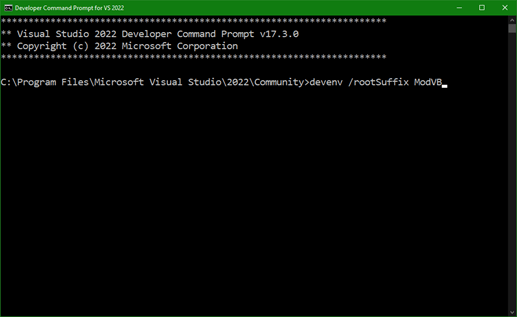
  • Open the Visual Studio 2022 Developer Command prompt (Start > “Dev…”)
    • Enter the command `devenv /rootSuffix ModVB`
  • Click “Continue without code” (bottom right)

You can always confirm when you’re using the ModVB hive because “MODVB” will appear in the upper right corner of Visual Studio 2022 when you’re using that hive.

  1. Add the ModVB MyGet VSIX feed to Visual Studio as an additional VSIX gallery
    • On the menu, open “Extensions > Manage Extensions”
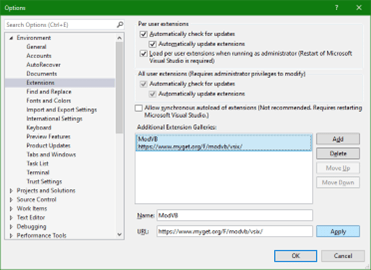
    • Click “Change your settings for Extensions” (bottom left)
    • Under “Additional Extension Galleries”, add a new gallery
  • Click “Apply” and then “OK”
  1. Download and install the ModVB Language Services extension
    • On the menu, open “Extensions > Manage Extensions”
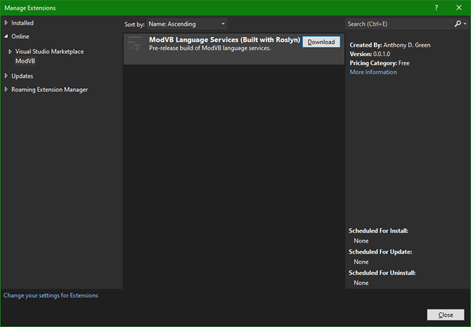
    • On the left, select Online > ModVB
    • Download the “ModVB Language Services (Built with Roslyn)” extension
  • Close Visual Studio 2022
    • The VSIX Installer will open. Follow the instructions in the installer to complete the installation
    • Re-launch the Visual Studio 2022 ModVB hive by entering `devenv /rootSuffix ModVB` at the Developer Command Prompt. You may wish to create a separate Windows shortcut with this option for convenience.

Installing the language services VSIX enables any new or modded IDE experiences inside of Visual Studio 2022, including the IDE experiences for new language features such as IntelliSense, syntax highlighting, and code actions. However, for building projects using new or modded language features and semantics you’ll need to reference the ModVB compiler from those projects. This also enables those projects to build as part of your CI/CD process on build servers which won’t have Visual Studio 2022 or the ModVB Language Services VSIX installed.

  1. Add the ModVB MyGet NuGet feed to Visual Studio as an additional NuGet package source
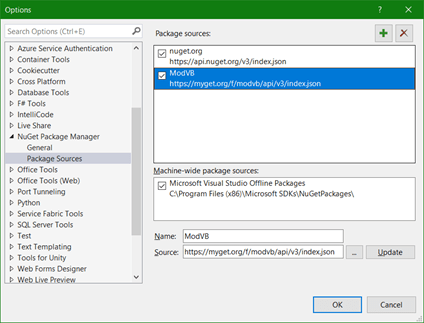
    • On the menu, open “Tools > NuGet Package Manager > Package Manager Settings”
    • On the left, select “NuGet Package Manager > Package Sources”
    • Add a new package source
  • Click “Update” and then “OK”
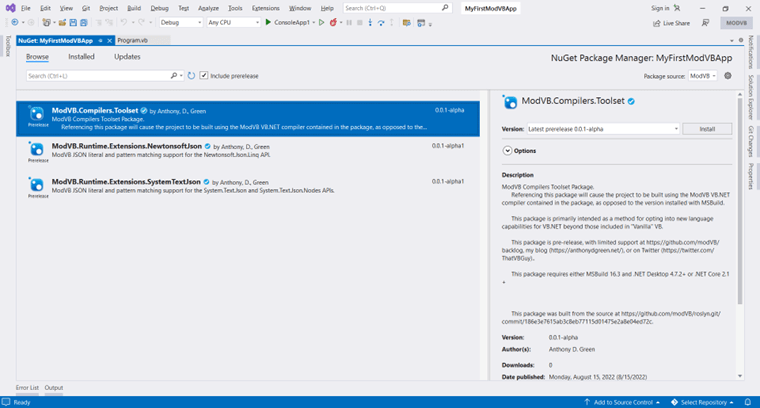
  1. Install the ModVB.Compilers.Toolset package to any projects you want to compile using new language features
    • On the menu, open “Project > Manage NuGet Packages…”
    • At the top, select Browse
    • Select the ModVB package source in the drop down at the top right
      • Make sure “Include prerelease” is checked (next to search box)
    • Select “ModVB.Compilers.Toolset” on the left
  • Click “Install” on the right

Congrats! Your project will now build with the ModVB compiler and have access to new features for VB.NET. Of course, if you’re not using these features the behavior of building will be exactly the same as before. Remember to add this package to any additional projects where you wish to use new functionality. Happy coding!

Next steps

  • Read this post detailing the new features in “Wave 1” of the ModVB alpha
  • Try out the mod—do anything you’re interested in doing with the new features
  • File bugs at https://github.com/modvb/backlog/issues
  • Feedback and discussion on my blog, your blog, Twitter, YouTube, or wherever you hang out with other VB.NET enthusiasts!
  • Don’t forget to SHARE!

Checking in (Wave 1) Update 2 SP4 R3

This is waaaay overdue, I know. So here’s what happened. That little bit of scope creep I decided to take basically reset the whole sprint. I didn’t have to throw away any of the code but it did expose every assumption that was in code and multiplied my testing matrix by like 4-5x because I’m supporting many more use cases than before. I’d say the effort has been 40% new code, 60% testing.

Also I took a week off due to prior commitments away from my keyboard with friends and family.

So why did I decide to increase scope so late? Precisely because of how disruptive this change has been. If I didn’t do it now I’d be compelled to do it immediately after Wave 1 and it would interfere with waves 2-3 which are entirely different feature areas. All of the assumptions would be more entrenched and there was a good risk of shipping things that were wrong in subtle little ways–I definitely had to withdraw certain functionality that was overly specific. And aside from the “happy path” experience which was originally designed, I had to design and test a whole “graceful failure” path. This is essential work for tooling anyone else is going to use. Nothing has been wasted in this effort.

So where are we at? I’m writing more tests. I admit I’m not nearly as fast a tester as I am a dev and switching hats makes me miss the days of having dedicated QA. I’m fixing minor bugs. Don’t have an exact release date but “soon” ™.

Regards,

-ADG

P.S. I’m going to publish what’s in Wave 2 BEFORE it starts. I appreciate that the suspense is problematic.

Checking in (Wave 1) UPDATE

After due consideration I’ve decided to delay today’s release to next week. I’m concerned that rushing testing/stabilization will only hurt … everybody so I’m giving it more “bake time”. Additionally, I’ve relented on some critical (minor) scope creep in the same areas being tested/stabilized now; it’s beneficial for a lot of reasons to do it now instead of as part of Wave 2. This new work is thematically consistent with what I had planned to release today, very important to the broad utility of that feature set, was half-implemented already–it was designed for from the beginning, and I’m kind of excited by it in an ice cream on top of pie kind of way.

Regrets,

-ADG

Checking in (Wave 1)

Just leaving a quick note for readers curious about my progress. In my last post I said I was working on an initial preview release of my mod with some new features. I’ve basically been heads down coding since I wrote that post and I finally punched through and end-to-end spike of an initial set of use cases.

I pull up a video of this scene literally any time I get any non-trivial amount of code to run as expected.

Now comes the fun part, rigorous automated testing of 100+ test cases and more bug fixing. Making sure that not only do things work the way I expect where I expect but that they don’t work in other ways where I don’t expect and that everything that does work does so for the right reason(s) and that nothing crashes. The bar is far higher for even a preview of a mod than for my past prototypes so I have to really go at things with hard pipe-hitting, blowtorch- and pliers-wielding permutations now.

This bug bashing is what I’m up to for the next 48-hours then on Friday (just in time for the weekend) I plan to publish some bits to play with. I also have to script and record a brief video explaining what to actually play with.

Fingers crossed! We’ve got a long road ahead of us and this first step is tremendously important. See you soon!

-ADG

An Alternate Path

It’s funny how a tiny bit of feedback can change the nature of a post. I had originally planned to write about modding in the gaming community and the impressive accomplishments independent developers and enthusiasts have had in expanding and extending the experience of games, sometimes vastly, beyond the intent of the original creators (e.g. Breath of the Wild: Second Wind). In some cases, games have come to be defined by their modding culture (e.g. Skyrim) and in others mods have taken on a life of their own to become products that arguably overshadow their base games (e.g. Counter-Strike) or even spawn new genres (e.g. Dota). I had some anecdotes about the first software I ever “modded” (Mavis Beacon Teaches Typing) or twiddling with QBasic games’ source code as a young teen.

That said, I got a bit of feedback after my last post that something maybe a little broader (yet also more direct and specific) would probably be better received so I’m going to try to fumble through distilling at least some of two years of thought and research and—yes, planning—into an elevator pitch. Well, maybe not that short, but still a challenge of brevity.

For starters, let me set a few expectations. Firstly, what I’m proposing is without a doubt going to be a pain in the ass, at first at least. It’s a lot of work. When I say a community-driven­­ path forward, I don’t mean a community-accentuated path forward. I don’t mean community-supplemented or community-enhanced. We need to shift our entire paradigm from being a Microsoft-centric developer experience to one where almost (*) everything we enjoy comes from us. That means features, tools, designers, docs, samples, templates, and even the respect that I mentioned in my last post. These are all things we’re used to getting from Microsoft and lamenting when we don’t get them from Microsoft and complaining to Microsoft about it. That entire inclination has to die and we have to rebuild a community that holds itself primarily accountable for its own capabilities.

This is not going to happen overnight and it’s not going to start just because I say “go”. I’ve seriously thought through the process, and I can’t see it taking less than a year or two to build out an experience with the kind of polish that can sustainably grow our community. But virtually all the technical pieces we need to build… well, anything, are available somewhere. The extensibility points are there; we just have to do the work both functionally (in code) and culturally (in ourselves). If you were looking for “ThatVBGuy” to post on his blog with some tablets in hand explaining how with a few reg key fixes I can make this all go away, sorry, this ain’t that post. We’re talking 3 steps back, 5 steps forward.

Though technically we’re not sliding backward, we’re just not moving forward right now, so I guess it’s just 5 steps forward while the world is moving forward like 2-3 steps maybe but we’re going to accelerate so that by the end of it we’re far ahead of where we are and even ahead of where we would have been if we just floated along with the current. Yes, we’re in a boat now even though when I started this parenthetical I was thinking about a land-vehicle like a car or a train.

I also want to be clear that not everybody is going to make it to the other side (we’re back on land now, the metaphor is some kind of chasm, I think). It’s completely foreseeable that a lot of us are going to take a faster, easier path and move to a developer experience that’s already propped up elsewhere. There are always going to be those who need a Microsoft-sanctioned/supported solution and either can’t or won’t give up the Microsoft-centric mindset. And that’s okay! I just can’t be one of those people and I’ll explain more about my personal investment in this (other than quitting my job to focus on kickstarting this effort for the next few months) in my next post.

Now, I know I’m not the first to say this is what needs to happen. Everything I’ve said so far will need to be said again, and expanded upon, and most importantly discussed and debated amongst ourselves—we few. So I have to imagine when people say, “Well, what’s the alternate community-driven path?” they already get that the path is to be community-driven. What they really are asking is “How?”, or “Where do we start?”, or “What can I do?”. Maybe they want a roadmap to give them assurances or confidence that this can really be done or how likely it is to be done in a way and timeframe that is applicable to their projects and needs.

For starters, what can you do as a VB.NET developer who wants to help?

Get comfortable with discomfort. We can build some great experiences but first we’re going to build some pretty raw ones. If the minority of the larger VB community that cares to push it forward can’t suspend our discomfort with doing things in a way that may seem initially hacky, we’re not going to get to the place where the majority can follow. Remember that most other languages outside the Microsoft ecosystem are built up like this. VB has enjoyed a long period of being the exception. Now we must rise to meet the rule.

Understand the systems that exist today. You’ve used Visual Studio and .NET but do you understand the extensibility points? Have you ever built a VS editor extension? How well do you understand the dotnet command driver? How’s your NuGet package authoring skill? Do you truly understand how new UI platforms work under the hood? Have you ever written a .NET Analyzer? A source generator? This is the time to pick an area of interest and study up. We’re all going to have our areas of strength and no one person can know or do it all.

Be ready to engage. It’s easy to be attracted to the allure of being the one who comes up with or builds exciting stuff. But what gets projects done and done right is feedback. I’m going to post a lot on my blog as things progress. Be ready to share your opinions and discuss with others. Be ready to test things that are built by others. Roslyn is arguably the largest VB project ever built and it crossed the finish line not just because of smart devs churning through features but equally smart testers constantly testing the bits. Giving feedback on the design. Filing bugs. Fixing bugs. Building projects with what was ready. I hesitate to quantify it but an amazing tester filing bugs is worth maybe 5+ good devs checking in features.

What’s Anthony doing?

First up, I’m building a mod as a proof of concept. This is a different animal than the prototypes and stuff I’ve built so far (think more Resharper than io.js). I’m targeting this month (June) so I plan to have something more concrete to talk about in the next two weeks. Aside from the at-times agonizing process of authoring these posts, this is now my full-time (unpaid) job. And as I learn more, I hope to educate others about how to do the same and begin to coalesce our identity and efforts into everything I can see in my mind’s eye that the VB experience is capable of being.

Need more info?

Sound off in the comments below!

-ADG

Two Anxieties and One Unarticulated Need

Why doing nothing is sometimes the right thing to do

In several of my recent conversations with folks in and out of the community, I’ve shared some things that they found—and a lot of my readers will probably also find—surprising.

A few years back I penned (as I do) a voluminous response, regarding VB, culminating in an open letter. What may surprise you is that after writing it I really didn’t attempt to socialize it much. I shared it on Twitter but in my experience that’s not actually a VB community hotspot at all. I had initially planned to make a bigger fuss but as I considered next steps and took counsel with those I trust I came to realize that the cycle of inaction-fire-response was just as likely to produce a terrible outcome as a good one (if not more so). Also, I was sleeping a little easier.

You see, in my first 2 years post Microsoft I wrestled with (among other things) two different anxieties regarding VB. I feared that:

1. The C#/.NET org wouldn’t do anything.
2. They would do something and it would be horribly wrong.

And every few months I’d peek in on vblang and find neither an announcement that they weren’t doing anything nor any announcements that they were doing anything in particular. And strangely I’d feel relief for both.

As a side note: if either had happened in 2018 or 2019 I genuinely wouldn’t have been mentally healthy enough to handle it so “do nothing, say nothing” in this case worked out well for me at least.

The Anxieties

In my 8 years at Microsoft attending VB language design meetings and product planning meetings I was constantly pushing back against the idea that the ideal for VB.NET was to “just do what C# does”. “That’s what the customers said they want! They’ll yell at us if we don’t!” Countless discussions that “co-evolution” never meant copying. It was exhausting but a fight worth fighting and after several years eventually I’d built the credibility to really shake that idea out of the heads of those within my sphere of influence.

That idea is wrapped in arrogance and bias and short-sightedness and genuine ignorance and intellectual laziness and yes, good intentions. But good intentions don’t always yield good results.

I’ll restate this plainly because people don’t seem to believe this about me (and I say this with no malice or insult intended): I experience no jealousy toward anything C# has. C# is a phenomenal language with great tooling, but C# has never produced an end-to-end experience in language or tooling that I have wanted to make my permanent home. The “spirit of the language” is different than mine and it can’t be gently nudged into being a great or even begrudging substitute. C# can add functional features, I don’t think the F# community will ever be like, “Yeah, good enough! I’ll switch” and I don’t think adding more imperative/mutable features to F# would allow one to wholesale lift-and-shift the C# community over to F#.

That’s not to say that I dislike capabilities that come to C#. There are many things I’ve wanted before C# even thought of them, and things they’ve gotten that I’ve only been grateful to have missed, and other things I’ve wanted in a very different way than they’ve appeared in C#. But there is nothing that I want because it’s in C#. But the problem is that “everybody” thinks that’s what I would or should want and frame decisions in that way.

Examples time!

So in 2015 we were working on the first release of VB powered by Roslyn. At one point in the cycle we’re prioritizing our backlog for the compilers/languages and I note that we’re doing question-dot (?.) aka “null-conditional member access” next. My dev lead had somewhat recently (re)joined the team and hadn’t been exposed to my philosophy over the years.

He nods his head agreeingly and says, “…Right! Because of co-evolution”.

Me: “No.

Not because of co-evolution.

Because in a private discussion thread with VB MVPs they expressed to us emphatically that `?.` was a top value-add for them. It has nothing to do with C#. The fact that C# also decided to do it is purely coincidental but has absolutely zero bearing on the fact that VB is doing it. We were always going to do it and if C# decided not to do it tomorrow we’d still be doing it“.

Interestingly, there was a heated internal debate on the question-dot (?.) operator while designing it. I can’t recall if this ever went public but the team was split on whether it should be left-associative or right-associative. That is to say whether a?.b.c should mean the same thing as (a?.b).c (left) or a?(.b.c) (right). The former is more compositionally pure and that was the argument that initially led the C# LDM to push forward with left-associativity. But there’s a pitfall there because if a is null, .c will throw an exception. Instead, in order to avoid the exception you’re forced to type a?.b?.c, which is what led the VB LDM to immediately push for right-associativity. Ultimately C# swung around to the right way but it was only after escalating the debate to an executive override. I honestly didn’t expect it and was fully prepared to die on the hill that VB go its own way here despite how “easy” and “comfortable” and “safe” it is to “just do what C# does”. Fortunately that fight never came but I still maintain that it was a fight worth fighting and that it could have very easily gone the other way.

Again you might be surprised to learn that I spent half my time on that release and the one following it convincing folks that we didn’t need to do features in VB. Specifically, that we didn’t need to deprioritize capabilities that would be genuine value-adds to the VB community and the VB experience for the sake of implementing or even pursuing the many ideas that were coming out of the C# design process. The vast majority of those ideas never even made it into C# because of various problems but the impact on the VB side was that they took time and oxygen away from features and approaches that would have benefited VB greatly. But C# was considering them so we had to spend cycles deliberating how they might work in VB.

When we first reached language completeness on the Roslyn compilers and were officially ready to implement new features rather than just attaining feature parity with the native compilers written in C++, I recall a moment when my dev lead (a different one) came to me inquiring about the necessity of the VB LDM: “Maybe we’re at a place where we ought to just ya know, let the C# LDM handle it?”. You see, he truly read both the need of the VB community (and the meaning of the co-evolution strategy) to be that the C# LDM would just do its thing and then skin those features into VB. I explained that this was not the case, but it takes a lot of time and credibility (which fortunately I had) to correct that misunderstanding one person at a time across a giant organization and then across an entire community. I see now that my inability to scale myself was one of my many failings.

The last interaction that comes to mind was from a high level director within developer tools. You see, we had this private mailing list where all of our VB MVPs and trusted influencers could talk shop and give feedback to the team. And anytime anything was amiss anywhere in the .NET ecosystem with regard to VB that list would flame up with someone dramatically proclaiming that this tool or that template was the last straw and that all hope was lost unless nascent technology Y got 500 samples immediately (care to guess how many of those tools, templates, or technologies are now “dead” btw?). Anyway, I sent out a reply asking for patience and calm, as I often did (another failure of mine) and this director privately replied that it was a good response but that he didn’t really see a way out of it as the only way the VB community could ever be happy was if we did everything for VB that we did for C# (in the same way and) at the same time. I absolutely do not believe that could make the VB community happy. I don’t believe doing that ever could have made us happy.

That mindset is like a virus running rampant through both the halls of Microsoft and the broader .NET community and for 10 years of my life I was steeped in anxiety about it all the time. More at some times than others and especially for the first two years where I wasn’t there to fight against it. And then one day “The .NET Team” announced that they had no plans to “evolve” the language further and that anxiety quickly went away. No more fear that some unconcerned and maybe well-intentioned person’s “whoopsie!” mistake would permanently mar the language with an inconsistency or some other mistake. No more fear that the loudest voices in the VB community which really do (for lack of leadership or imagination) yell as often as not for complete replication of C# in almost all respects would find purchase amongst some newer and unwary members of the team and we’d finally get that Semicolon keyword.

And my other anxiety, that nothing would happen. Well, that happened, so there was nothing to fear there anymore either. And in the first few months following the announcement while certainly anxious about COVID-19; racism, police violence, and civil unrest; murder hornets, and economic collapse, for the first time in a very long time VB was something I wasn’t anxious about.

The Need

In the past when Microsoft CEO Satya Nadella has spoken of using empathy to meet the unarticulated needs of users he’s reiterated that this isn’t the same as going off and doing exactly what the most and loudest users tell you; that’s why it’s (often) unarticulated. I haven’t found an exact quote but the closest was here where he says, “It’s not about going where people tell you to, but how you get there before there is conventional wisdom”.

So, if “feature parity” with C# is the red herring—the articulated want that doesn’t actually meet the need—then what is the thing that VB users need. What is all the clamoring and complaining and commenting and protesting really about (beyond the obvious cases of being technically blocked in some task)? The answer is surprisingly human:

Respect

The VB audience articulates a lot but behind it all is a very human and professional need to feel respected. Everything else is just a means to that end. Respect from their peers in other language communities. Respect from Microsoft for their decades long business relationship. Respect for their code, and their projects, their knowledge, and skills.

I have a t-shirt (that I never wear) that was given to me one year at MVP Summit that reads “VB.NET IsNot VB6”. What that shirt really says is “Respect me (unlike you treat people who use VB6)”. Every time any VB.NET developer has uttered a phrase distancing themselves from VB6 or VB6-isms it’s because they perceive that doing so gets them more respect. In the mid 2000s, when I was getting into .NET, I did the same thing. “Oh no, you don’t understand, it’s not like VB6 anymore—it’s okay, you can respect me now—I use inheritance!”. I’ve never worn that shirt, that I can recall, and have no plans to because I no longer believe that it’s okay to disrespect someone else as a means to building up your own cachet. But for many VB.NET developers this is still an instinctive and desperate move to scratch up what they really want: respect.

And co-evolution. When a VB.NET developer said “We have the co-evolution promise now” it wasn’t because they were getting the features they actually needed, or wanted, or used. It was a defense from a disrespectful industry. The oft-misapplied idea of co-evolution was a shield that said “You have no concrete examples to disrespect me because I will have the same things as something you do respect”. But make no mistake, copying C# doesn’t create respect. It just deflects superficial disrespect. If you have two children, is it respecting one to treat them exactly like the other always? “I took your sibling to baseball games so I always took you to baseball games ergo I respect you; I bought them blue shoes so I bought you blue shoes—ergo I respect you both equally”.

I recall once 5+ years ago we put out a preview of some potential new features in VB. One of which was the ability to perform a Select Case on the type of a value. Someone wrote in through the “Contact Us” form on the VB team blog and said (paraphrased) “I’m very worried about the direction of VB.NET. I see that you’re thinking of adding this Select Case on type feature but object-orient developers should use polymorphism and method overriding to get different behaviors based on the type of an object and I’m afraid this feature teaches bad habits and is dumbing down the language”. I can’t remember if I replied or what I said but I do recall asking Mads to chime in for some reason and he politely explained that while polymorphism was certainly one way to approach such problems, in functional programming languages it’s very common to use constructs like a type case or pattern matching to do the same things and that we were looking at expanding the languages with other constructs and techniques popularized in functional programming, etc. I’ll never forget the complete 180 in the customer’s response (paraphrased) “Oh! Functional programming! I’ve heard of that! Sounds neat!”. You see, once he understood that the feature was coming from a position of respect for his intelligence and not a crutch, he was completely open to it. Tying it to modern programming techniques like functional programming rather than pre-OOP procedural habits lent legitimacy and respectability to the feature and him and his code in using it by extension.

I can’t tell you how many times someone in the VB.NET community has come to me and said they read that Microsoft was going to evolve VB in a way that was true to the spirit of the language and that this meant “dumbing it down” and that we needed to change to present it as raising the bar of entry or removing the training wheels or some other condescending metaphor. This defensiveness is about respect. Co-evolution was about respect. The distancing from VB6 is about respect and the envy of C# is about respect but none of these things actually meets the need of respect. It’s an unmet and unarticulated need that can’t be solved easily or quickly or superficially.

This isn’t a need that can be met by everyone just “resolving” that they “respect” VB.NET developers. But it can be met, I believe. It’s going to take a lot of work and as much or more of it is cultural (about the community) as it is functional (about features and support). So, you see, I didn’t make as big of a fuss as I thought I would because the last thing we needed then and now is for “The .NET Team” to be startled by some fire drill or protest into doing “whatever” puts out the fire most quickly. Any little addition or change from “The .NET Team” no matter how innocuous or well-intended is as likely to cause as much harm as good to the VB experience unless rooted in the deepest reverence for what VB has already and is, has been, and still can be. I don’t think this is a change that can come from Microsoft and that it’s best that we, the community, take the lead for now. i.e. it’s for the best that outsiders sit on their hands for a bit longer. In my next post I’ll begin to talk about an alternate (and exciting) community-driven path forward that I see. Stay tuned.

Regards,

-ADG

How Do I Love VB, Let Me Count the Ways…

You know, I’ve been waiting to use this title on Valentine’s Day for two years. I realized after I posted my exhausting list of differences post that that would have been the perfect title but by then it was too late so, naturally, I’ve just been waiting for February 14th to roll around again… and again.

Anyway, it’s even better now because Valentine’s Day this year falls the day after a very special anniversary. Yesterday marked TWENTY YEARS since the release of Visual Studio .NET 2002 and with it the first release of Visual Basic .NET! That’s a long time.

To commemorate the occasion, a good friend shared with me this book he’d acquired way back in the day with a title that perfectly sums it up:

Visual Basic .NET and the .NET Platform

Just WOW. When this chapter… or section, in the history of VB started I was a junior in high school. I hadn’t even truly discovered the .NET flavor of VB yet but a few years later that changed and my career changed forever.

I’ve been giving lots of thought to the next chapter. But first, I want to try finally putting out that Part II of my list of differences in keeping with the “let me count the ways” title. I tried to get it out by today but it’s been slow going. I’m actually on vacation and hoping to get a good deal more writing done than normal so maybe it’ll come this week. Fingers crossed.

Well, that’s it for now. I vaguely recall encountering or remembering  few extra differences since my first post but I didn’t write them down and have since forgotten them. Hopefully I remember at least 6 more that I can add so I can cross 100 ways I love VB.NET.

Happy Birthday .NET and VB .NET (and C# too); Happy Valentine’s Day everyone and thanks for reading!

Warm and fuzzies,

-Anthony D. Green

Enthusiasm

This post was written in reverent memory of two colleagues who have passed away since I worked with them, Kieran and Howard. Rest in Peace.

Today’s post is written (in part) from PAX West 2021 in Seattle, which jives well with today’s topic: Enthusiasm. Much of the best parts of my life revolve around enthusiasm. Conventions like PAX, Star Wars Celebration, and BlizzCon are—more than just marketing events—celebrations of enthusiasm. My closest friendships are built around a common currency of enthusiasm for topics and activities. We talk often and at length about our favorite games, movies, TV shows, books, and technology. My preferred YouTube content is from creators with enthusiasm for literature, health, teaching, or just knowledge in general. The online communities I participate in are powered not by organizations but the enthusiasm of their community members. I remember my favorite time of year as a Program Manager on the VB team was MVP Summit because of how exhilarating it is to just be around others who are enthusiastic about programming in my favorite language on my favorite platform. I realize that though across a wide range of domains, at my core I’m an enthusiast. In fact, when Microsoft first approached me about interviewing for the role of PM of the VB.NET compiler back in 2009 that’s precisely how I signed my email accepting the invite. Not “Professional IT Solutions Consultant” or “Enterprise Software Architect” but “Visual Basic Enthusiast Extraordinaire”.

In the beginning of this year, I mentioned taking a break from social media to get some quiet, so to speak. I’m happy to say one of the words to tumble out of that quiet was this: enthusiasm. Not fandom. Not fun or favoritism. Not ego. Not even love or passion. I’d been thinking about my reasons for continuing to think about VB and in VB and those other words while certainly undeniable to various degrees didn’t feel super defensible to me as a case for why anyone else should care what I have to say, how I feel, or what I do. Not defensible to these imaginary critics, btw, but defensible to me. But unlike loving what you do, or having a fun job, or being a fan of your tools, I think it’s pretty difficult to argue that a life, professional or otherwise should be carried on devoid of or without regard to enthusiasm. That doesn’t mean that every single day I sit at my desk and laugh hysterically and post on Instagram videos of my saying “Isn’t this so fun!? My desk is the happiest place on earth today!” but there’s still a general enthusiasm (what defines and encourages that enthusiasm is a topic for later) for the field taken on the whole that I believe is absolutely worth fighting for.

While pondering this idea several people come to mind, some as counter examples, but I’ve decided today to focus on the positive. Specifically, two immensely respected past colleagues with inspirational careers who have since passed on and I’d like to talk a bit about how they’ve influenced my thinking on this topic.

The first of which is a man who I didn’t interact with very often personally but who was one of several role models for me at Microsoft. When I joined the Visual Studio (Managed) Languages team I was advised to get a few mentors and I did. My peer mentor’s mentor was a man named Kieran. Kieran said something that I’ve never forgotten and which I think summarizes what I mean when I talk about enthusiasm, “I always want to run those last few steps to my office in the morning”. And whenever I remember Kieran, that’s how I picture him, hustling to his office toward whatever the day’s challenges were. Not that every day was a trip to the amusement park but that, on the whole, he was going somewhere he very much and wholeheartedly wanted to be. That’s the example he set for other PMs and for me and his loss 3 years ago no doubt left the world dimmer for a lot of folks for a lot of reasons.

Another person who’s been on my mind is Howard. I worked with Howard a little over a decade ago in Chicago. When he joined the company I was then at, he was already in his mid-60s. He was the most knowledgeable person I knew about business process orchestration and far from thinking about retirement he was always thinking about what was next. His enthusiasm for his work was inexhaustible. I ran into him a few years into my time at Microsoft and he was still at it as of last year in his mid-70s. I think of Howard as an example of a long and wholehearted career. Sadly, when I went to look Howard up before writing this post, I learned he passed away late last year. I left my condolences with the family through a page they set up and I repeat my sympathies here. This loss to his family is of course beyond my comprehension and words and I will always cherish his time in my life as a respected, amicable, and resilient colleague and as an inspiration.

I could go on listing individuals near and far who “worked” in their fields in their 50s, 60s, 70s, or 80s and beyond, from Sir. C.A.R. Hoare in computing to Dr. Anthony Fauci in immunology, other members of public service, entertainment, and industry. I mention all of this to say… I’m 36 (37 in exactly 1 month). When I think about some of the brilliant and tireless minds I’ve worked with on the Roslyn team and the length of a career there’s a very real possibility that I’m not even halfway through mine. There could be another 40+ years of me giving a damn in the general vicinity of computers and programming in some form or fashion. How do I want to spend them? Rolling out of bed in resignation or running those last few steps?

Something happened to me, y’all. I once referenced fighting to stay on a platform, but I realize I’m in a fight for my very enthusiasm for what could be a longer period of time than I have been on the Earth. Will I be silent? Will I connect with others? How? Do you know how many times someone I know or who knows someone I know has contacted me and said “I want to get started with programming, where do you recommend I start?” and I genuinely just had emptiness in my heart and nothing to say? This has been true for several years now, at least 4. I lost something vitally important because I let externalities convince me that my own enthusiasm didn’t matter. That it was immature, trivial, or irrelevant. At times in the last 5 years, I’ve thought of myself as on a journey looking for the soul of something and this year I’m realizing that my soul is at least part of what I’m looking for.

What’s the impact if I give up on that search or if I bow out of that fight? The impact for me personally? The impact on others, or the lack thereof because I never share what I’ve learned along what has been a rich career (that’s not even half done yet). And this has made me think about what enthuses me about our industry and what definitely does not (and it’s not precisely a particular tool or product, btw). Anyway, in this time of silence I’ve resolved that while I might face a lot of criticism no one can ever tell me that it’s wrong for me to fight for my enthusiasm for the next 40 years of my career and my life. Not just as a clinically depressed person but as a human being I believe that’s however narrow the odds, that’s always worth fighting for!

Regards,

-ADG

P.S. My next post has been titled “Two Anxieties and an Unarticulated Need” but I’m on the fence on how soon to post it. I’ve been holding on to it for over a year and I’ve sort of lost track of whether it’s important to say it now. I’m leaning yes but thoughts change. I’m at least leaving you the title, so you know there is a next post. There’s always a next post.

PHP

I’ve been learning to love PHP every day for a little over a month now. Not that one—gotcha! No, I mean I’ve been attending a Partial Hospitalization Program. So 5 days a week for 5 hours a day I’ve been at a facility with a team of mental health providers (therapists/social workers, psychiatrists, nurses, etc.) doing everything from finding me a new medication regiment for my depression and anxiety to regular individual therapy sessions as well as group therapy up to 3 times per day.

If that sounds intense, that’s because it is. Once again, I find myself on a mental health-related medical leave from work. This time I’ve taken 12-weeks of protected time under the 1993 Family and Medical Leave Act to try to finally get some treatment for various conditions mental and physical that I really wasn’t able to deal with last year in 2020 the way that I wanted to. As literally everyone on the planet knows, the entire healthcare infrastructure of… Earth was overloaded throughout 2020 and the mental health component was no exception. At times I had one or two month waits just for a single visit with a therapist and now I’m almost living with a whole crew of them.

I’ve actually recently transitioned out of PHP and have just started what’s known as IOP or the Intensive Outpatient Program. It’s just a truncated form of the same program as PHP, I just leave 2 hours earlier and will eventually transition down to 3 or fewer days of program per week as I try to transition back into “normal” life.

For a minute I wasn’t sure why I decided to write this other than simply as an update for the small number of folks on the planet who might take an interest but, earlier this year I was reminded by a very good friend that my talking about mental health has made it a little easier for other people dealing with struggles in their own lives or their families beyond anything particular to me. And that’s a second great reason to share.

I’m not blaming this all on last year, though last year was stressful for many ambient reasons. There were also family issues not directly related to the global situation (and some were) on top of the same challenges I struggled with in 2019… and 2018…. and 2017… and 2016… and you get the picture. I’m a little more positive now because I have the experience of taking a leave from Microsoft for 2 months in the spring of 2017. I know what to expect and what to avoid or embrace more fully.

One thing I thought I was prepared for but clearly am not, is fighting with insurance companies. I thought I was ready for them this time but nope. Actually, this whole last two years has been very educational about the horrors and intricacies of the health provider-insurance complex. It might be fun for me to engage as a software development if I weren’t an often barely functional patient just seeking help. It turns out that someone with a dangerously pessimistic world view and a constant sense of impending doom, failure, rejection, opposition, judgement, and punishment isn’t the person to take phone calls from an angry bureaucrat and they should probably appoint someone to advocate for disabled persons like myself in these situations. But I digress.

I guess my midyear update is this: I’ve taken some body-blows but I’m in treatment, baby-stepping back to the things in life I love. Whoever and wherever you, if you or someone you know is or has been on the ropes lately (and I think that describes a lot of us) I hope you/they have/can find the resources needed to get back to what you love. We all need to get back to more love.

On that note, my next post will be on enthusiasm.

Warmest regards,

-ADG